
Affordable lighting updates can make your home feel cozier faster than almost any other change, and most of them cost less than a new throw pillow. Swapping a cool bulb for a warm one, adding a plug-in dimmer, moving a lamp to the darkest corner or putting a light on a timer can change how a room feels in a single evening.
Lighting matters so much because it shapes the mood of every room after dark. A room lit by one bright ceiling fixture can feel flat and a little clinical, while the same room glowing with a few warm lamps feels like a place you want to stay. The good news is that getting there rarely requires an electrician, a remodel or a big budget.
The Homey Hygge approach is to start with what you already have and fix the most annoying lighting problem first. This guide walks through ten affordable lighting updates, from shopping your own home for lamps to renter-friendly sconces and smart plugs, so you can make your home feel warmer without spending much at all.
TL;DR: Budget Lighting Ideas for a Cozier Home
To make your home feel cozier on a budget, start by moving lamps you already own to where you actually need light. Swap cool bulbs for warm LEDs around 2700K, add plug-in dimmers, and put one extra lamp in each room’s darkest corner. Refresh tired lampshades, use smart plugs or timers so lamps turn on before dark, try plug-in wall sconces, and add battery-powered accent lights. Finish with warm string lights or flameless candles, and use mirrors and light surfaces to make every lamp go further.
10 Affordable Lighting Updates That Make Your Home Feel Cozier
You don’t need to do all ten. Pick the one that fixes the room that bothers you most, then come back for the next.
Budget Lighting Ideas at a Glance
- Shop your home for light first.
- Swap cool bulbs for warm LEDs.
- Add dimmers without rewiring.
- Add one lamp where the room is darkest.
- Refresh your lampshades.
- Put lamps on smart plugs or timers.
- Try plug-in wall sconces.
- Add battery-powered accent lights.
- Use string lights and flameless candles thoughtfully.
- Make your light go further.
Shop Your Home for Light First
The most affordable lighting update is the lamp you already own, moved to where you actually need it. Many homes have lamps sitting in rooms nobody uses in the evening while the main living space relies on one harsh overhead light.
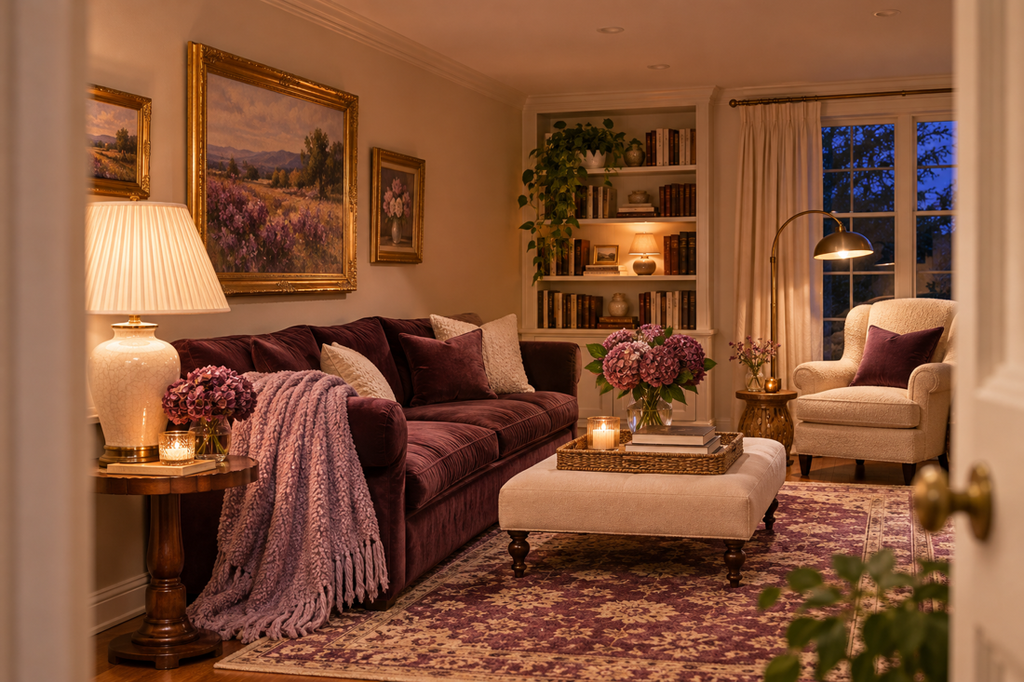
How can I make my home cozier without buying new lights?
Walk through your home and gather every lamp you own, including the ones in guest rooms, closets and storage. Move them to the rooms you use most at night, place them beside the seats people actually sit in, and switch off the overhead light to see the difference.
It’s surprising how often the coziest lamp in the house lives in the room nobody sits in after dinner. A table lamp from a spare bedroom can transform the corner of a living room, and a forgotten floor lamp can finally give that reading chair the light it’s been missing.
Start with the room where you spend your evenings. Turn off the overhead light, turn on every lamp, and notice the dark spots, the seat no one could read in and the corner that disappears after sunset. Those gaps tell you exactly where to move your lamps first.
This is also a good moment to notice what’s not working. A lamp hidden behind a sofa, a bulb that’s far too bright or a shade turned yellow with age are all easy fixes, and none of them require buying anything new.
Lighting You May Already Have
- Lamps in guest rooms or home offices: often unused in the evening.
- Floor lamps tucked in corners: move them beside seating.
- Desk lamps: useful as reading lights in a pinch.
- String lights from the holidays: a warm glow on a shelf or mantel.
- Spare bulbs in a drawer: check them for warmer options.
Homey Hygge Tip
Try the evening walk-through tonight. Turn off every overhead light in your main living space, turn on every lamp, and stand in the doorway. Wherever you see a dark corner or an unlit seat, that’s where your next lamp belongs.
Swap Cool Bulbs for Warm LEDs
Swapping cool white bulbs for warm LEDs is one of the quickest, most affordable ways to make a room feel cozier. Look for bulbs labeled soft white or warm white, around 2700K, especially in the rooms you use at night.
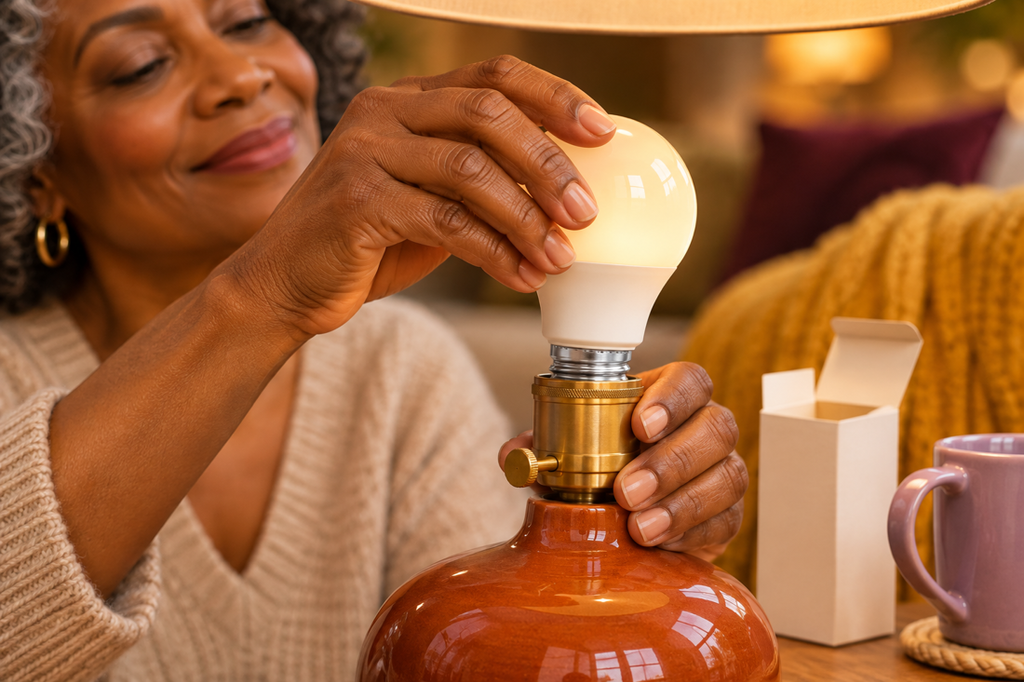
What light bulbs make a room feel cozy?
Warm white or soft white LED bulbs around 2700K give off a golden glow that feels relaxed and inviting. Cooler bulbs labeled daylight, usually 5000K or higher, look crisp and bright but can make a living room or bedroom feel more like an office after dark.
Bulb color is measured in Kelvin and printed on the package as a number followed by K. Lower numbers look warmer and more golden, while higher numbers look whiter and bluer. Many homes end up with a mix of both after years of replacing bulbs one at a time, which is why one lamp can look cozy while the lamp beside it looks cold.
LED bulbs also save money over time. According to the U.S. Department of Energy, residential LEDs, especially ENERGY STAR-rated ones, use at least 75 percent less energy and can last up to 25 times longer than incandescent bulbs. That means a warm LED swap makes a room cozier and can lower your energy use at the same time.
When you shop, check two things on the package: the color temperature for warmth, and lumens for brightness. A bulb that’s warm but too dim won’t help much, so match the lumens to the old bulb you’re replacing.
Not sure which bulb color belongs in which room? Our guide to warm vs. cool lighting walks you through it, room by room.
Warm Bulb Shopping Tips
- Look for 2700K: labeled soft white or warm white.
- Check lumens: match the brightness of the bulb you’re replacing.
- Choose dimmable: if you plan to add a dimmer later.
- Consider color-adjustable bulbs: warm in the evening, brighter by day.
- Replace the most-used lamps first: the living room and bedroom.
Homey Hygge Recommendation
Take a quick photo of the base of every bulb in your living room before you shop. It’s an easy way to remember the size, brightness and color you need, and it saves a return trip when the bulb you bought doesn’t fit.
Add Dimmers Without Rewiring
Plug-in dimmers let you turn almost any lamp down to a soft evening glow without hiring an electrician. They plug into the wall, the lamp plugs into them, and you get a slider, dial or remote to control brightness.

Can you add a dimmer to a lamp without rewiring?
Yes. A plug-in lamp dimmer sits between the lamp and the outlet, so there’s no wiring involved. The one catch is the bulb: it needs to be labeled dimmable, because non-dimmable LEDs can flicker, buzz or fail on a dimmer.
Dimming is one of the biggest differences between a room that’s simply lit and a room that feels cozy. Being able to lower the light in stages lets one lamp go from bright enough to read by to a soft glow for a movie or a quiet evening.
In our home, I rely on lamps with built-in dimmers and color-adjustable smart bulbs, and I lower the light in stages as the evening goes on. You can get much of the same effect with a plug-in dimmer and a dimmable warm bulb in the lamps you already have.
If your lamp’s outlet is hard to reach, some plug-in dimmers come with a small remote or a wireless switch you can keep beside the sofa or bed. Smart plug-in dimmers can even dim on a schedule, which leads nicely into the timers and smart plugs coming up later in this guide.
Dimming matters most in the bedroom, where the right light helps you wind down. For more ways to light your bedroom for rest, see our guide to cozy bedroom lighting ideas.
Easy Ways to Add Dimming
- Tabletop plug-in dimmer: a slider or dial that sits on the table or floor.
- Plug-in dimmer with a remote: handy when the outlet is behind furniture.
- Smart plug-in dimmer: control from your phone, voice or a schedule.
- Dimmable smart bulbs: dimming built into the bulb itself.
- A lamp with a built-in dimmer: the simplest option when buying new.
Homey Hygge Tip
Before buying a dimmer, check the bulb in your favorite lamp. If the package or base doesn’t say dimmable, swap it for one that does at the same time. It’s the difference between a smooth glow and a flickering lamp.
Add One Lamp Where the Room Is Darkest
Adding a single lamp to the darkest corner of a room can make the whole space feel warmer and larger. It’s often the most noticeable lighting update you can make for the price of one lamp.

Where should you put lamps in a living room?
Place lamps beside the main seats so people can read, plus at least one in the darkest corner so the room doesn’t fall into shadow at night. A mix of heights, such as a table lamp, a floor lamp and a small accent lamp, makes the light feel layered rather than flat.
A room lit only from the center has bright middles and gloomy edges. One lamp in that dark corner balances the light, pulls the eye across the room and makes the space feel finished. It’s amazing how often a dark corner is what’s quietly making a room feel uncomfortable at night.
You don’t need to buy new to do this. Thrift stores, estate sales and secondhand marketplaces are full of beautiful lamps for very little money, and a vintage lamp with a fresh shade can look like a deliberate design choice.
If you buy a secondhand lamp, check it before you plug it in. Look for a cord that’s frayed, brittle or cracked, and a socket that looks discolored or scorched. Those are signs the lamp needs to be rewired with new UL-listed parts by an electrician or lamp repair shop before you use it.
Where an Extra Lamp Helps Most
- The darkest corner: balances light across the room.
- Beside a reading chair: with the light falling over your shoulder.
- On a console or entry table: a warm welcome when you come home.
- On a bookshelf: a small lamp tucked among books.
- In a kitchen corner: a soft light for evenings after cooking.
Homey Hygge Recommendation
When shopping secondhand, bring a bulb with you and ask to test the lamp before buying. Then inspect the cord and socket closely, because a lamp that turns on isn’t automatically a lamp that’s safe.
Refresh Your Lampshades
A new lampshade can change both how a lamp looks and how its light feels, often for far less than a new lamp. Fabric shades soften and warm the light, while a colored shade can add personality and a gentle tint.

Does the color of a lampshade change the light?
Yes. Light passing through a fabric shade picks up a little of its color, so cream and ivory shades give a soft, warm glow, while colored shades like lavender, sage or terracotta tint the light slightly. Thicker or darker shades send more light up and down instead of through the sides.
Old shades often turn yellow, dusty or dented over the years, and a tired shade can make even a good lamp look dated. Swapping it is one of the quickest ways to make a room feel fresher without buying new furniture.
Think about the mood you want. A white or cream linen shade spreads soft, even light, which is great beside a reading chair. A pleated or patterned shade adds charm and a bit of vintage personality. A colored shade is a lovely, low-risk way to bring in a color you love, and if you’ve been nervous about color, a lampshade is about as gentle a start as it gets.
Check the evening effect before committing, since a strongly colored shade can tint the whole corner. For more ideas on bringing color in without it feeling overwhelming, see our guide to Colorful Hygge: How to Create a Cozy Home Without Going Neutral.
Lampshade Updates to Try
- Cream or ivory linen: soft, warm, all-purpose light.
- Pleated shades: a bit of vintage charm.
- A colored shade: lavender, sage, terracotta or a color you love.
- Patterned fabric: florals or stripes for personality.
- A fresh clean: dust or lint-roll shades you already love.
Homey Hygge Tip
Take your lamp with you when shopping for a new shade, or at least measure the old shade’s top, bottom and height. Shades that look right in the store often end up too big or too small once they’re home.
Put Lamps on Smart Plugs or Timers
Smart plugs and simple timers turn your lamps on automatically, so your home is already glowing when the evening starts. They’re inexpensive, easy to set up and especially helpful on dark winter afternoons.

Should lamps turn on before it gets dark?
It helps. Setting lamps to turn on about 30 minutes before sunset makes the shift from daylight to evening feel gradual instead of sudden. A timer or smart plug handles it for you, so you never walk into a dark house.
I love natural sunlight during the day, so in our home the lamps are mostly an evening habit. Having them come on by themselves as the light fades is one of those small luxuries that makes coming home feel warmer, especially in the darker months.
A basic plug-in timer is the most affordable option. Smart plugs add more flexibility: you can turn lamps on or off from your phone, set different schedules for weekdays and weekends, or have lights follow sunset times automatically. Some smart dimmer plugs can even lower the brightness at bedtime.
Timers are useful for safety and peace of mind, too. Lamps that switch on while you’re away make a house look lived in, and lights that turn off automatically mean nobody falls asleep with the living room lamp blazing all night.
Simple Automation Ideas
- A plug-in timer: turns a lamp on and off at set times.
- A smart plug: schedules, phone control and sunset timing.
- A smart dimmer plug: dims lamps gradually in the evening.
- An entry lamp on a timer: a warm welcome when you come home.
- An auto-off at bedtime: so lights don’t stay on all night.
Homey Hygge Recommendation
Put one lamp in your main living space on a timer set for about 30 minutes before sunset, and adjust it as the seasons change. After a week, you’ll wonder how you ever managed without that automatic glow.

Free 7-Day Printable
Make Your Home Feel Cozier in 7 Days
Small lighting swaps make a big difference, and so do small daily steps. The free 7-Day Homey Hygge Home Reset gives you one easy, budget-friendly change a day, and none of it starts with shopping.
Cozy emails, no clutter. Unsubscribe anytime.
Try Plug-In Wall Sconces
Plug-in wall sconces give you the look of built-in lighting without any wiring, which makes them perfect for renters and small spaces. They free up tabletop space and put warm light right where you need it.
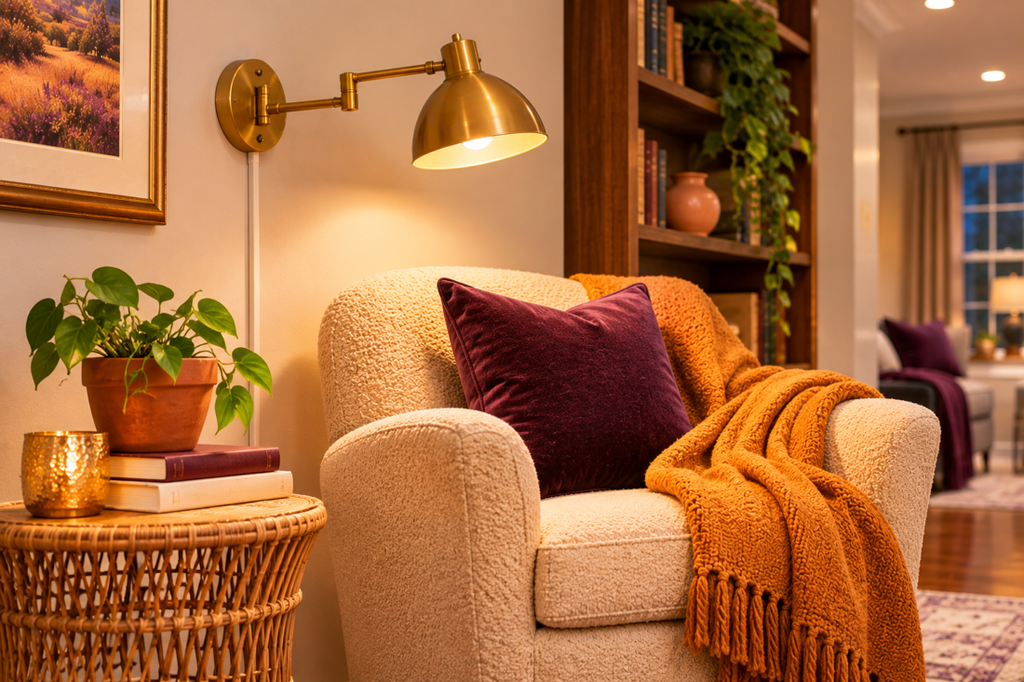
Are plug-in wall sconces renter friendly?
Yes. Plug-in sconces mount with a few screws or sturdy adhesive hooks and plug into a regular outlet, so no electrician or rewiring is needed. Many come with cord covers you can paint to match the wall so the cord blends in.
Sconces work beautifully beside a bed, over a reading chair, flanking a mirror or in a narrow hallway where there’s no room for a lamp. Swing-arm styles are especially useful for reading, since you can aim the light right at your page and push it back when you’re done.
Because they’re mounted on the wall, sconces also add a layer of light at a height between your table lamps and the ceiling. That middle layer is part of what makes a room feel warm and evenly lit rather than bright in one spot and dark everywhere else.
When installing, plan the cord path before you drill. Keep it as straight as possible down to the outlet, and use a cord cover or a small table or plant stand to hide it if you’d rather not see it.
Where Plug-In Sconces Work Well
- Beside the bed: frees up the nightstand.
- Over a reading chair: focused light without a floor lamp.
- On either side of a mirror: flattering, even light.
- In a hallway or entry: a warm glow where lamps don’t fit.
- Above a desk or kitchen nook: light without taking up surface space.
Homey Hygge Tip
Before mounting a sconce, tape a piece of paper to the wall at the height you’re considering and sit in the chair or bed beside it. Make sure the light will fall where you need it and the shade won’t sit at eye level and glare.
Add Battery-Powered Accent Lights
Battery-powered and rechargeable lights add small pools of cozy light in places without an outlet. Puck lights in shelves, cordless table lamps and small accent lights make bookcases, cabinets and corners feel warm without any cords.

What lights can I use where there’s no outlet?
Rechargeable cordless table lamps, battery-operated puck lights and small LED accent lights all work without an outlet. Choose warm white versions and, ideally, ones with a remote or timer so you’re not climbing onto furniture to switch them on every night.
Accent lights are the finishing layer that makes a room feel cozy rather than just lit. A soft glow inside a bookcase, a small lamp on a dining table or a puck light under a kitchen cabinet adds warmth and depth at very little cost.
Accent light doesn’t have to come from something sold as a lamp, either. In our living room, the light on my plant stand turned out to be one of the coziest glows in the house, and it does double duty keeping my plants happy.
Cordless lamps are especially handy on dining tables, outdoor tables and shelves where a cord would look messy. Many recharge by USB and last an evening or more on a charge, so you can move them wherever you want a little extra warmth.
Cordless Accent Light Ideas
- Rechargeable table lamps: for dining tables, shelves and nightstands.
- Puck lights: inside bookcases, cabinets or under shelves.
- LED picture lights: a soft glow over a favorite piece of art.
- A plant light: a cozy glow that also helps your plants.
- Remote-controlled accent lights: easy to switch on without reaching.
Homey Hygge Recommendation
Pick one shelf or cabinet that disappears into shadow at night and add a single warm puck light or cordless lamp. Living with that small glow for a week will show you how much a little accent light changes the feel of a room.
Use String Lights and Flameless Candles Thoughtfully
Warm string lights and flameless candles add an affordable, gentle glow that instantly feels cozy. Used in small doses, they make a shelf, mantel or window feel special without turning the room into a holiday display.

Are string lights cozy or tacky?
They’re cozy when they’re warm white and used with restraint, such as tucked into a garland, draped along a bookshelf or wrapped around a mirror. They start to feel tacky when they’re cool white, colored, flashing or used on every surface at once.
String lights are one of the most budget-friendly ways to add a soft, twinkling layer of light. LED versions run cool and use very little energy, and fairy lights with thin copper wire practically disappear, leaving just the glow. A jar of them on a shelf or a strand tucked into greenery on the mantel can make an ordinary corner feel magical.
Candles are the traditional symbol of hygge lighting, and one or two can be lovely. I’m allergic to traditional candles, though, so in our home the glow comes from lamps, dimmers and flameless candles instead. Good flameless candles with a warm flicker and a timer look surprisingly real and can sit safely in windows or near curtains.
If you do burn real candles, the National Fire Protection Association recommends keeping them at least 12 inches from anything that can burn and blowing them out before you leave the room or go to sleep. For more ideas on creating a warm glow without relying on candles, see our guide to Hygge Lighting: How to Create a Warm, Cozy Glow at Home.
Soft Glow Ideas
- Warm white fairy lights: in a jar, a garland or along a shelf.
- String lights around a mirror: doubles the glow.
- Flameless candles with timers: for windows, mantels and tables.
- A few real candles: placed safely and never left unattended.
- Plug-in lanterns: warm, portable and cord-tidy.
Homey Hygge Tip
If you buy flameless candles, look for ones with a built-in timer. Set them to turn on in the early evening and off a few hours later, and you’ll get a candlelit glow every night without lifting a finger.
Make Your Light Go Further
You can make the lights you already have feel brighter and warmer by helping them bounce around the room. Mirrors, light-colored surfaces and simply cleaning dusty bulbs and shades all make every lamp work harder for free.

How do I make a room feel brighter without more lamps?
Place a mirror across from or beside a lamp or window to reflect light deeper into the room, and keep lampshades and bulbs free of dust. Lighter walls, shades and textiles also reflect more light, while very dark surfaces absorb it.
Mirrors are one of the oldest lighting tricks for a reason. A mirror behind a lamp on a console or across from a window spreads light and makes a room feel larger and more open, especially in a small space.
Surfaces play a role, too. Paint companies measure how much light a color reflects with a number called light reflectance value, and lighter colors reflect more of the light around them. That doesn’t mean you have to give up color, since a warm, mid-tone wall can still glow beautifully with the right lamps, but it helps to know why a dark corner might need an extra light.
The easiest trick of all is cleaning. Dust on bulbs and shades dulls their glow over time, and a quick wipe can make a lamp look noticeably brighter. It’s the most budget-friendly lighting update in this whole guide, and it takes about five minutes.
Light-Boosting Tricks
- A mirror across from a lamp or window: spreads light further.
- A mirror behind a lamp: doubles the glow on a console or mantel.
- Lighter lampshades: let more light through.
- Clean bulbs and shades: dust dulls the light.
- Open daytime curtains: sheer panels let in more daylight.
Homey Hygge Recommendation
Pick one evening this week to dust every lampshade and bulb in your main living space, with the lamps switched off and cooled first. Then turn them all back on and notice how much fresher the room looks.
Frequently Asked Questions About Budget Lighting Ideas
What is the most affordable way to make a room feel cozier?
Move lamps you already own to the seats and corners you actually use in the evening, then switch off the overhead light. Swapping cool bulbs for warm 2700K LEDs is the next most affordable step and makes a noticeable difference.
Do LED bulbs make a room feel cold?
Only if they’re cool white or daylight bulbs. Warm white LEDs around 2700K give off a golden glow similar to old incandescent bulbs, while using far less energy.
How can renters improve lighting without changing fixtures?
Renters can use lamps, plug-in dimmers, plug-in wall sconces, smart plugs and battery-powered accent lights, none of which require rewiring. Swapping bulbs in existing fixtures is usually fine too, as long as you keep the originals to put back when you move.
Are plug-in dimmers safe to use with LED bulbs?
Yes, as long as the bulbs are labeled dimmable and the dimmer is rated for LEDs. Non-dimmable LEDs can flicker, buzz or fail when used with a dimmer.
How many lamps should a living room have?
There’s no single rule, but most living rooms feel cozier with several light sources at different heights rather than one overhead light. A lamp beside each main seat plus one in the darkest corner is a good place to start.
Is it safe to use a thrifted lamp?
It can be, once you’ve checked it. Look for frayed, brittle or cracked cords and discolored sockets, and have any questionable lamp rewired with UL-listed parts by an electrician or lamp repair shop before using it.
Light Your Home Like You Mean to Stay
A cozier home doesn’t start with a shopping list. It starts with moving a lamp, swapping a bulb or turning off the overhead light and seeing how much warmer the room feels. Most of the updates in this guide cost very little, and several cost nothing at all.
Pick the room that bothers you most at night and try one change this week. Notice how it feels, then add the next one. Little by little, those small updates add up to a home that glows warmly every evening.
Continue Creating Your Homey Hygge Home
Ready to plan your lighting room by room? Read Hygge Lighting: How to Create a Warm, Cozy Glow at Home for how to layer ambient, task and accent light throughout your home.