
Hygge lighting means lighting your home with several lamps and other low light sources instead of one bright ceiling fixture. The light is warm and soft, and it is one of the simplest ways to make your rooms feel comfortable in the evening.
Picture your living room lit two ways. Under a single overhead light, it is perfectly functional and about as relaxing as a waiting room. With a few warm lamps at different heights, it becomes a room you want to sit down in.
Candles are the traditional symbol of hygge lighting, and they do have a real place in Danish homes. Hygge lighting is broader than candles, though. It is any soft, warm light placed where you and the people you live with spend your time.
I do not usually use candles myself, and I feel safer with lights, so this guide focuses on lamps and other electric light sources. As I’ve started intentionally bringing more hygge into our home, the method I rely on is lamps with built-in dimmers and adjustable smart bulbs. You can build the same kind of lighting in any home and any color scheme, often with lamps you already own. The steps below walk you through it: daylight, layers of light, bulb warmth, lamp placement, dimming, candles, and how to apply it all room by room.
TL;DR: Hygge Lighting: How to Create a Warm, Cozy Glow at Home
Hygge lighting means using several warm, soft, adjustable light sources at different heights instead of depending on one bright overhead fixture. Enjoy daylight during the day, then switch to lamps in the evening. Choose warm white bulbs around 2700K, and add dimmers or smart bulbs so you can change the brightness to suit what you are doing. Candles, string lights, and lanterns are optional extra layers, not requirements.
8 Steps to Hygge Lighting at Home
Good lighting comes together one step at a time. Each step below improves a different part of your lighting, and the first few cost little or nothing, so it makes sense to work through them in order before you buy anything new.
You do not need to complete all eight steps to notice a change. Two or three steps, done in the room where you spend your evenings, will show you what the rest of your home needs.
Hygge Lighting at a Glance
- Start with daylight and let lamps take over in the evening.
- Build three layers of light: ambient, task, and accent.
- Choose warm white bulbs and learn what the numbers on the box mean.
- Place lamps where people sit, read, and gather.
- Make brightness adjustable with dimmers and smart bulbs.
- Treat candles as one optional layer.
- Add a softer glow with string lights, lanterns, and overlooked light sources.
- Apply the system room by room.
Start With Daylight, Then Let Lamps Take Over
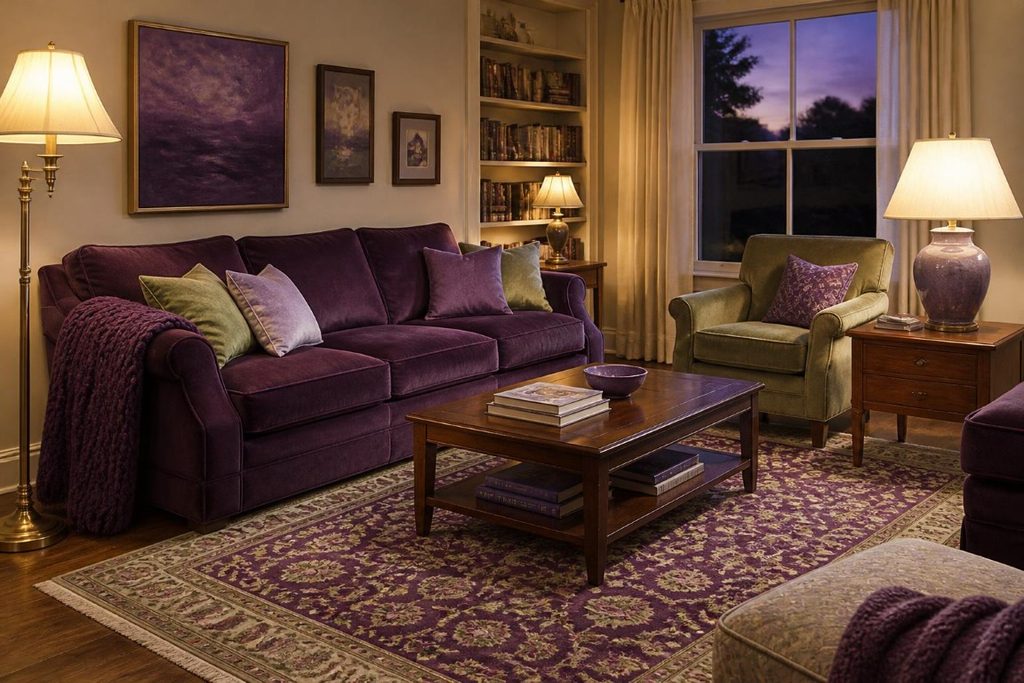
Hygge lighting begins with natural light. Use as much daylight as your room offers during the day, then turn lamps on as the sun goes down so the light changes gradually as evening arrives.
Does hygge lighting mean keeping rooms dim all day?
No. Hygge lighting is about comfort, and during the day comfort usually means plenty of natural light. The low, warm glow people associate with hygge belongs mostly to evenings and dark winter afternoons.
It is easy to assume a hygge home is dim at every hour, but a room with the curtains drawn at noon is gloomy, not cozy. Daylight is also the standard that light bulbs are measured against for showing colors accurately. That matters in a home built around plum, coral, sage, or whichever colors you love.
Daylight also helps you later on. Harvard Health Publishing recommends plenty of bright light during the day, noting that it supports your mood and alertness and makes it easier to sleep at night.
This is how it works in our home. I enjoy natural sunlight during the day, so my dimmable lamps and smart bulbs are mostly an evening habit. The lamps are not competing with the windows; they pick up where the sun leaves off.
During the day, your job is to manage sunlight, not add to it. Sheer curtains soften harsh direct sun, blinds or lined curtains control glare on screens, and a mirror beside or across from a window can bounce light deeper into the room. A chair near a window gives you a daytime reading spot that costs nothing to light.
Ways to Work With Daylight
- Hang curtain rods wider than the window so the fabric clears the glass completely when open.
- Use sheers where privacy or glare is the issue, so you filter light instead of blocking it.
- Keep tall furniture away from the window wall where you can, so it does not block the light.
- Notice which rooms get morning sun and which get afternoon sun, then use each room when its light is at its best.
- Turn lamps on before the room gets dark, so the change from daylight to lamplight feels gradual instead of abrupt.
Homey Hygge Tip
For one week, notice where you are sitting when you first reach for a light switch in the late afternoon. That seat is where the room most needs a lamp, and it is often a different spot from where the lamp currently sits.
When daylight fades earlier in the fall, our guide to creating a hygge home for autumn shows you how to keep every room warm and glowing.
Build the Room in Three Layers of Light
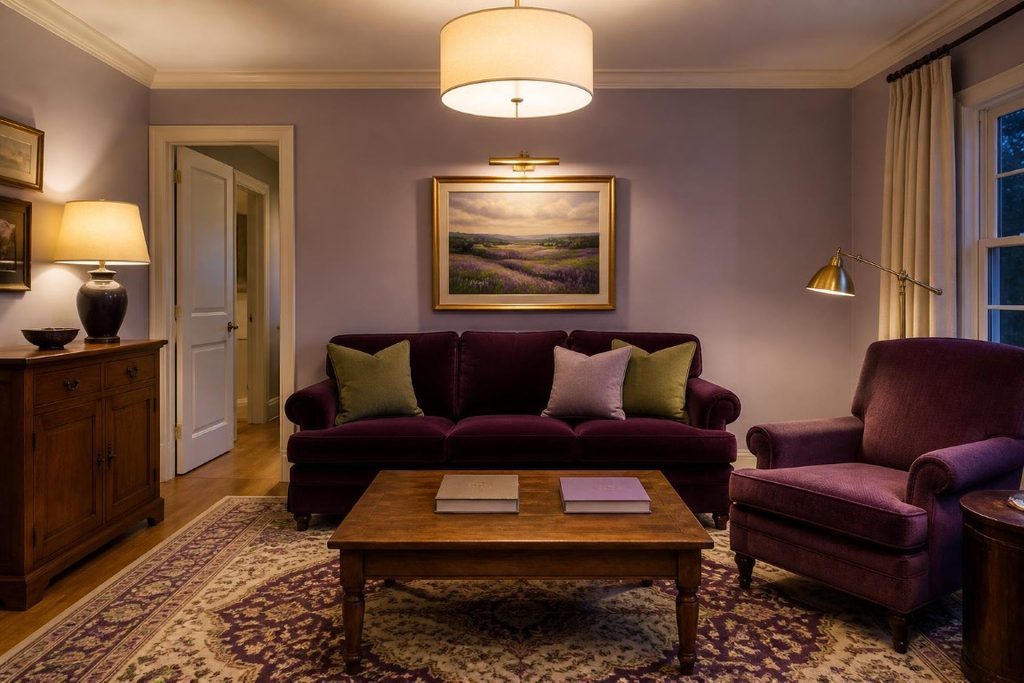
Layered lighting combines ambient light for general visibility, task light for specific activities, and accent light for atmosphere. A room with all three can shift from bright and practical to soft and relaxed without changing a single fixture.
Should a hygge room still have overhead lighting?
Yes. Overhead lighting is useful for cleaning, for finding whatever rolled under the sofa, and for any moment when you need to see the whole room. The goal is to stop depending on the overhead light as your only light source, and ideally to put it on a dimmer.
A single ceiling fixture lights a room from one point above, which makes everything beneath it look flat. The middle of the floor is bright, the corners are dim, and faces pick up unflattering downward shadows. Several lower light sources do the opposite. They create separate pools of light, so your room has inviting spots to sit, read, and talk.
Ambient light is the base layer and usually comes from ceiling fixtures, though a few lamps working together can do the same job. Task light is aimed at something specific, such as a book, a cutting board, or a crossword. Accent light is the smallest and softest layer, and it is the one most rooms are missing.
You do not need to buy all of this at once. Most rooms already have ambient light, so your first addition is usually a task lamp beside the seat you use most. One small accent light after that is often enough to finish the room.
The Three Lighting Layers
- Ambient: ceiling fixtures, flush mounts, torchiere floor lamps that bounce light off the ceiling, or several table lamps together.
- Task: reading lamps, swing-arm sconces, desk lamps, under-cabinet lights, and bedside lamps.
- Accent: picture lights, a small lamp on a bookshelf or console, lighting inside a glass cabinet, string lights, or a candle or two.
- A working minimum: aim for at least three light sources in a main living space, placed at more than one height.
Homey Hygge Tip
Tonight, turn off the overhead light and turn on every lamp in the room. Stand in the doorway and look for a dark corner or a seat where nobody could read. That gap is your next lighting project, and if there is no gap, you may not need to buy anything at all.
Choose Warm Bulbs and Learn What the Label Means
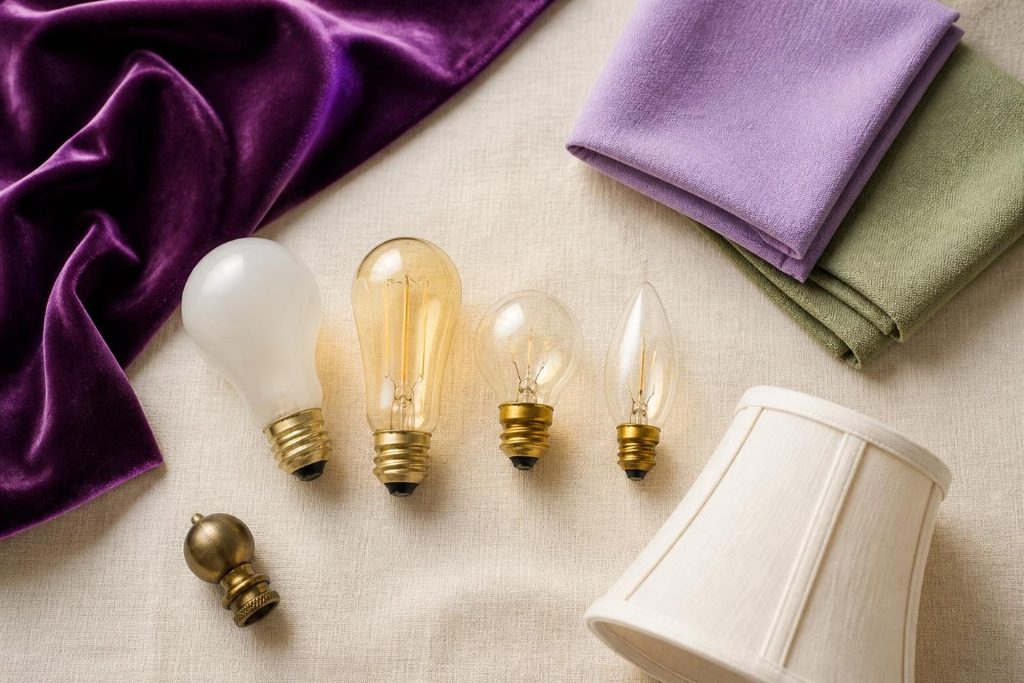
For cozy evening light, choose bulbs labeled warm white or soft white, around 2700K. Color temperature is measured in Kelvin, and lower numbers give a warmer, more golden light while higher numbers look whiter and bluer.
Is warm light always better than cool light?
Not always. The U.S. Department of Energy notes that cooler light produces higher contrast, which helps with visual tasks, while warm light is preferred in living spaces because it flatters skin tones and clothing. Many homes do well with warm bulbs where people relax and slightly crisper or adjustable light where detailed work happens.
Three numbers on a bulb box do most of the work, and the first is Kelvin. The Department of Energy classes roughly 2700K to 3000K as warm and 3600K and above as cool. Around 2700K is the classic warm white of an old incandescent bulb. Lower numbers look more amber, and higher numbers start to feel like office lighting.
The second number is lumens, which measure how bright a bulb is. Watts used to tell you that, but with LED bulbs they mainly tell you how much energy the bulb uses. By ENERGY STAR’s chart, about 450 lumens replaces an old 40-watt bulb and suits an accent lamp, while about 800 lumens replaces an old 60-watt bulb and is a sensible starting point for reading.
The third number matters most in a colorful home. The Color Rendering Index, or CRI, rates how closely a bulb shows colors the way sunlight does, on a scale up to 100. The Department of Energy considers 80 or higher acceptable for most homes. If you have gone to the trouble of choosing a plum sofa or coral pillows, though, a bulb rated 90 or above helps them look like themselves after dark.
Warm, lower light suits the end of the day for another reason. Harvard Health Publishing reports that light in the evening suppresses melatonin, a hormone tied to the body’s sleep cycle, and that blue-rich light does so more strongly. That is a general finding and not a promise about anyone’s sleep, but it is one more reason to keep your evening light low and warm.
Bulb Numbers Worth Knowing
| Color temperature | How it looks | Where it tends to work |
|---|---|---|
| 2200K to 2400K | Amber and candle-like | Accent lamps and evening-only lamps |
| 2700K | Classic warm white | Living rooms, bedrooms, and dining rooms |
| 3000K | Warm but crisper | Kitchens, bathrooms, and home offices |
| 4000K and above | Neutral to cool white | Garages, laundry rooms, and detailed task work |
- Brightness: about 450 lumens for accent lamps and about 800 lumens for reading.
- Color accuracy: CRI 90 or higher wherever color matters to you.
- Dimming: the box must say “dimmable” if you plan to use the bulb with a dimmer.
- Consistency: keep bulbs in the same room close in color temperature, because a 2700K lamp beside a 5000K lamp looks mismatched.
Homey Hygge Recommendation
When bulbs need replacing in the rooms where you relax, choose 2700K bulbs with a CRI of 90 or higher, and keep them consistent within each room. It is an inexpensive change that improves how every color in the room looks, which is a better return than most decorating purchases offer.
Place Lamps Where Life Actually Happens
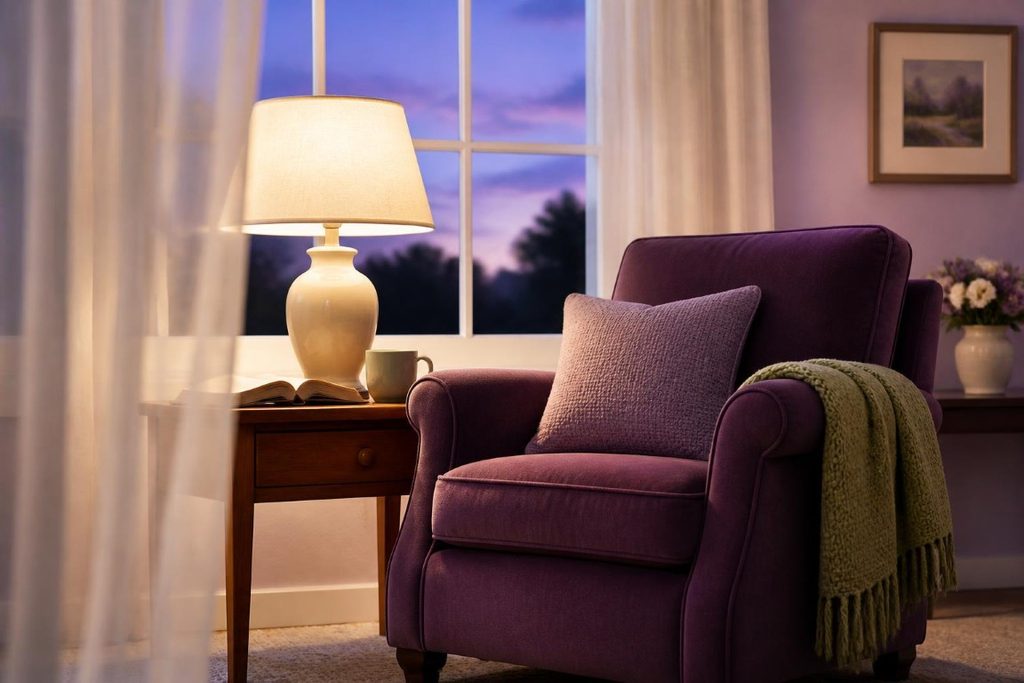
Place lamps beside the spots where you sit, read, talk, and work, not centered on a wall for the sake of symmetry. Set them at different heights around the room so the light forms overlapping pools instead of one bright zone.
How high should a table lamp be next to a sofa or bed?
A common guideline is that the bottom of the shade should sit at roughly eye level when you are seated. That way the light falls on your book or lap without the bare bulb shining in your eyes. If you can see the bulb from where you sit, the lamp is too tall, too short, or wearing the wrong shade.
Start with your seats, not your walls. Every chair where someone reads, knits, colors, or does the crossword deserves a light within reach. After that, look at the corners, because a lit corner makes a room feel larger and a dark corner makes it feel smaller.
In our home, the dimmable lamps sit on the larger side tables in the living room and on the nightstands in the bedrooms. A generous surface helps, because a lamp has to share its table with a book, a drink, and a pair of reading glasses.
Glare is the main thing to avoid, and Danish lighting has a long history of doing exactly that. Designer Poul Henningsen developed his three-shade lamp system in 1925 and 1926, then spent four decades with the manufacturer Louis Poulsen pursuing glare-free light and soft shadows. You do not need a designer lamp to borrow the principle: choose shades that cover the bulb and diffuse the light.
Outlets rarely sit where you need them, which is a real constraint and not a decorating failure. Plug-in wall sconces and rechargeable cordless lamps can light a spot that has no outlet or no table. Where you do use cords, the Electrical Safety Foundation International advises keeping them out of high-traffic areas, never running them under rugs or furniture, and treating extension cords as temporary.
Placement Priorities
- A lamp within reach of every seat where someone reads or works with their hands.
- Light in at least two corners of the room.
- Light sources at varied heights, such as a floor lamp, a table lamp, and something at shelf level.
- Shades that hide the bulb from both seated and standing eye level.
- Plug-in sconces or rechargeable lamps wherever there is no outlet or no surface.
Homey Hygge Tip
After dark, sit in each seat in the room and look around. If a bare bulb is visible from any of them, rotate the shade, lower the lamp, or swap in a frosted bulb. It takes about ten minutes and costs little or nothing.
Make Brightness Adjustable With Dimmers and Smart Bulbs
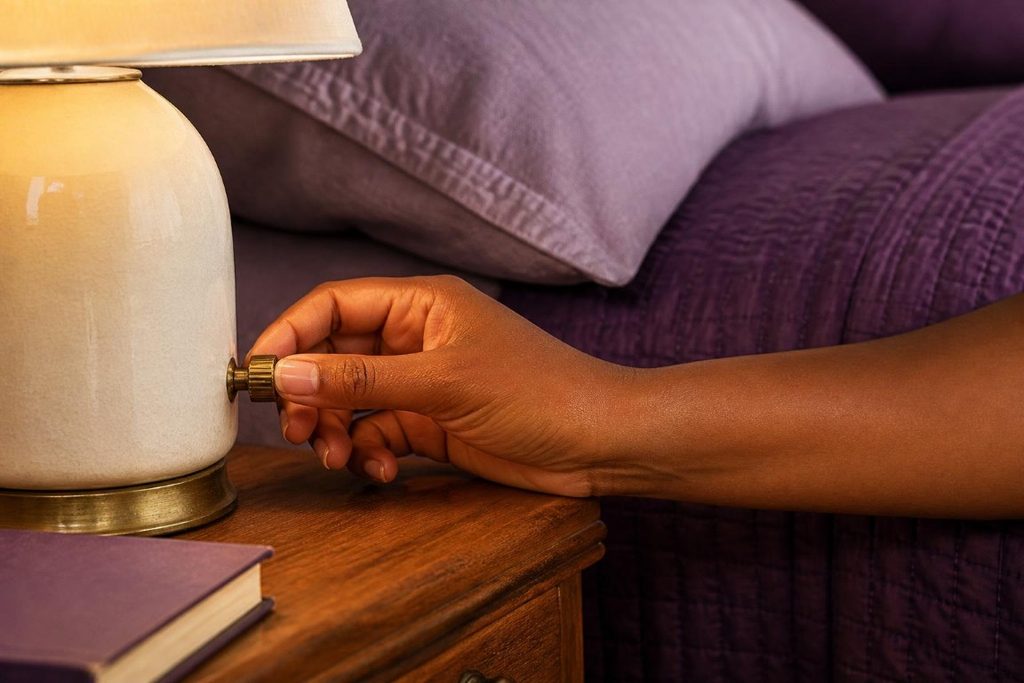
Adjustable lighting lets one room serve several moods. Dimmers, three-way bulbs, and smart bulbs allow you to lower the brightness, and in some cases warm the color, as the evening goes on.
Do you need to rewire anything to get dimmable lighting?
No. Lamps with built-in dimmers, plug-in lamp dimmers, three-way bulbs, and smart bulbs all work with ordinary outlets and sockets. Wall dimmer switches for ceiling fixtures are the one option that involves wiring, and that is a job for a licensed electrician.
This is the method I use in our home. Lamps with built-in dimmers and color-changing, adjustable smart bulbs sit in the bedrooms and the living room, and they do most of their work in the evening. For me they are also a practical alternative to relying on candles, which the next section covers.
A lamp with a built-in dimmer is the simplest place to start, because the control is on the lamp and there is nothing to set up. If you already own a lamp you love, a plug-in dimmer that sits between the lamp and the outlet does the same job. Either way, the bulb itself has to be labeled dimmable.
Smart bulbs go a step further. Many let you change color temperature as well as brightness, so the same bulb can be crisp at four in the afternoon and amber by nine. Some also offer full color, schedules, and saved settings, controlled from an app, a remote, or a voice assistant.
Two compatibility points save a lot of frustration. Not every dimmable bulb works well with every dimmer, and older dimmers built for incandescent bulbs can make LEDs flicker or buzz, so check the bulb maker’s list of recommended dimmers. Smart bulbs handle dimming inside the bulb itself, so they are meant for a regular on-off switch; read the instructions before pairing one with a wall dimmer.
One more detail explains why dimmed LEDs sometimes disappoint. Old incandescent bulbs turned more golden as they dimmed, but a standard LED stays the same color and simply gets fainter. Bulbs sold as “warm glow” or “dim to warm” shift from about 2700K toward 2200K as they dim, and smart bulbs with adjustable color temperature can do the same.
Ways to Add Adjustable Light
| Option | What it needs | Good for |
|---|---|---|
| Lamp with built-in dimmer | A dimmable bulb | The simplest start, especially on nightstands and side tables |
| Plug-in lamp dimmer | A dimmable bulb and a lamp you already own | Making a favorite lamp adjustable |
| Three-way bulb | A lamp with a three-way socket | Three fixed levels with no extra equipment |
| Smart bulb | An app, remote, or voice assistant | Changing brightness and warmth, plus schedules |
| Wall dimmer switch | LED-compatible dimmer and professional installation | Ceiling fixtures and hardwired sconces |
Homey Hygge Recommendation
If you are starting from nothing, make the lamp beside your usual evening seat adjustable first. One dimmable lamp in the right place earns its keep quickly, and a larger smart lighting setup can wait until you know what you want from it.
Treat Candles as One Layer, Not the Whole Plan
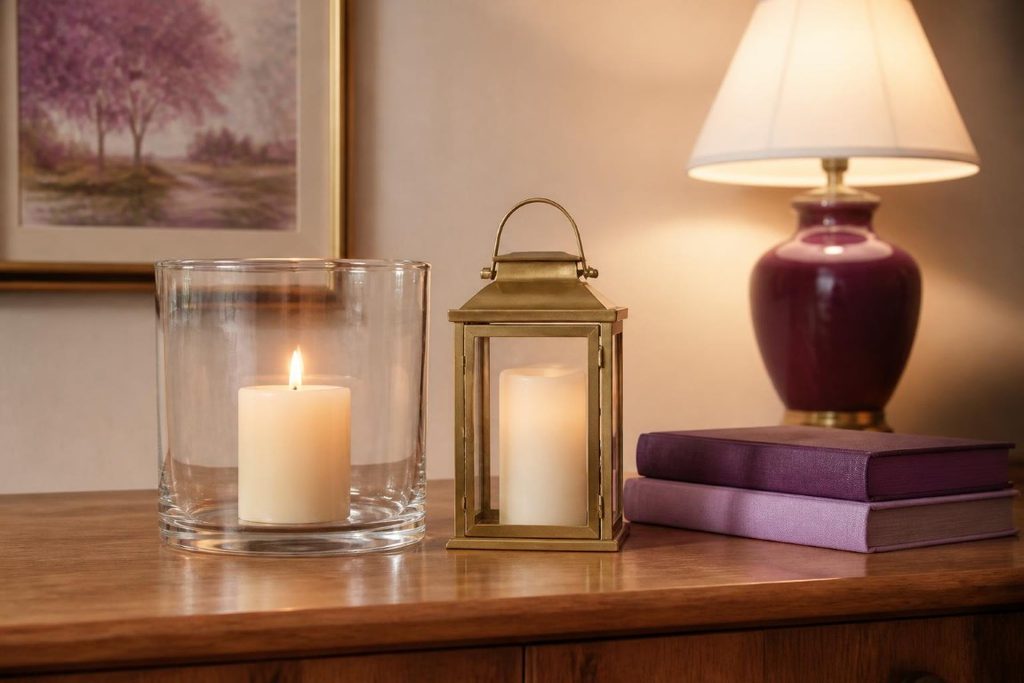
Candles have a real place in hygge, and one or two can add a living, flickering glow that no bulb fully copies. They work best as a small accent on top of good lamp lighting, and they are entirely optional.
Can a home be hygge without candles?
Yes. Candlelight is strongly associated with Danish hygge, but the feeling comes from warm, soft, low light and from how people use a room, not from wax specifically. Dimmable lamps, warm bulbs, and flameless candles can create a very similar atmosphere.
There is no point pretending candles are a marketing invention. VisitDenmark, the national tourism organisation, names the warm glow of candlelight among its first examples of hygge, and Danes call candles levende lys, literally “living light.” Homey Hygge has no quarrel with that. The quarrel is with the idea that a home without candles has somehow failed the assignment.
Denmark itself relies on candles less than the stereotype suggests. In a September 2023 YouGov survey for the Danish home knowledge centre Bolius, nearly two in three Danes said they light candles at home, and 22 percent said they use LED candles instead. Bolius also passes along the Danish Environmental Protection Agency’s advice to avoid sooty, flickering flames and to air the room after burning candles.
I have a personal stake in this one. I am allergic to traditional candles, so a room full of them was never going to be my version of hygge. Dimmable lamps and smart bulbs are what I rely on, and I feel safer with them. I am also starting to look into other wax options to see whether any of them work for me.
Paraffin is the most commonly used candle wax, according to the National Candle Association, with beeswax, soy, palm, and blended waxes also widely sold. The association, which is the industry’s trade group, says quality waxes all burn in much the same way. So I cannot tell you that any wax is safer for allergies or sensitivities, and I will report back on what I find as I try alternatives.
Fragrance is a separate question from wax. Emory University allergist Stanley Fineman has said that the chemicals in scented candles and air fresheners can set off sneezing and a stuffy or runny nose in sensitive people, and that a “natural” label does not make a product irritation-free. If you have allergies or asthma, your doctor is a better guide than a candle label.
I cannot tolerate most floral scents, so I stick with citrus, some woodsy scents, and spices. If florals bother you too, unscented is not your only option, though unscented candles are still worth keeping for the dinner table, where fragrance competes with the food.
Flameless LED candles have improved a great deal, and many now have real wax shells, a flicker effect, and timers. They remove the open flame, which is why the National Fire Protection Association suggests considering them, and why they suit lanterns, bookshelves, and homes with curious pets or small children. Where you do burn real candles, the association advises keeping them at least 12 inches from anything that can burn and blowing them out when you leave the room or go to bed.
Quantity matters as well. One or two candles on a stable surface give a room a glow. A dozen candles spread across every surface stop looking cozy and start looking like something the fire department would like a word about.
Candle Options to Consider
- Paraffin: the most common type and usually the least expensive.
- Soy, beeswax, palm, and blends: widely available alternatives worth comparing if paraffin candles do not suit you.
- Unscented: candlelight without fragrance, and the better choice near food.
- Non-floral scents: citrus, woods, and spices, for anyone who finds florals overwhelming.
- Flameless LED candles: a flicker effect and timers with no flame, smoke, or melted wax.
Homey Hygge Tip
Before lighting a candle out of habit, apply the Homey Hygge Test: does it make the space more comfortable, welcoming, personal, or enjoyable to use? If candles give you a headache, make you nervous around the cat, or sit unlit for months, a dimmable lamp is the more hygge choice for your home.
Add a Softer Glow With String Lights, Lanterns, and Overlooked Light Sources
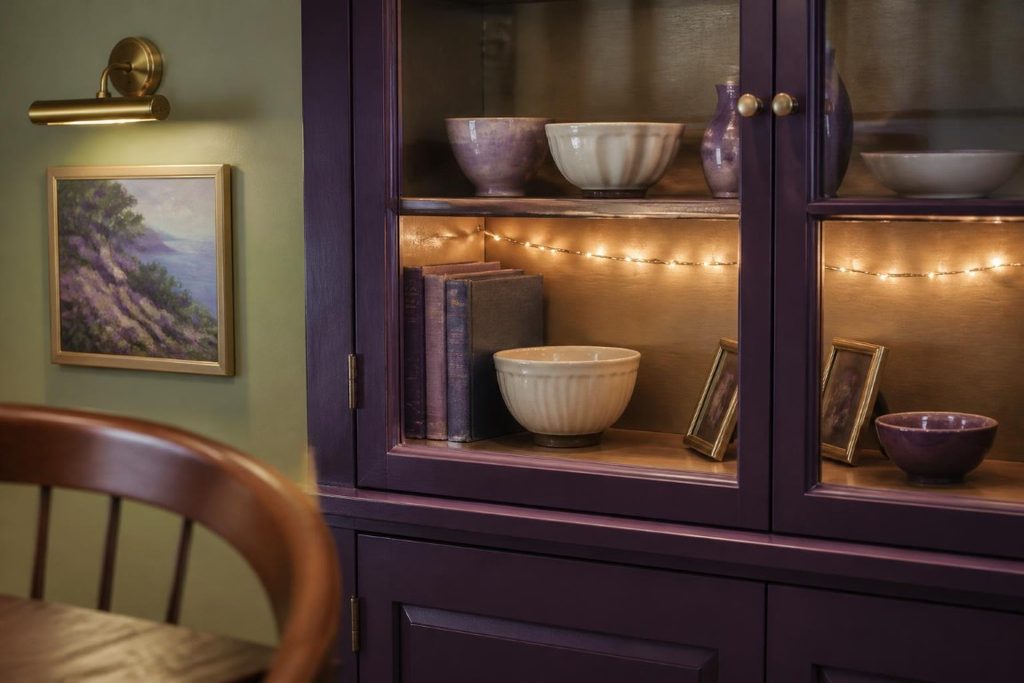
Small, low-brightness light sources such as string lights, lanterns, and picture lights fill the dark spots that lamps miss. They add atmosphere without adding much brightness, which makes them useful finishing touches.
Are string lights only for Christmas?
No. Warm white string lights can work all year when used with restraint, such as inside a glass-front cabinet, along one bookshelf, or on a covered porch. One strand in one place looks intentional, while strands in every room suggest the tree never quite came down.
Use these small lights to fill the gaps your lamps leave. A lantern on the hearth, a picture light over a painting, or a short strand of lights inside a cabinet gives your eye somewhere soft to land. They matter most late in the evening, when you have turned the brighter lamps down.
These small lights also make a room personal. A light aimed at a favorite painting, a shelf of family photographs, or a collection gathered over decades shows visitors what matters in your home. It makes your own belongings the focal point, which suits a home that has been collected over time.
Some of the best accent lights are ones you already own for other reasons. One surprise in our living room has been the plant light, which turns out to make nice cozy lighting as well. The light over your stove or the bulb inside a display cabinet can do the same job, so look around your home before you buy anything.
Seasonal lighting follows the same rules with a little more sparkle, and it gets its own treatment in Hygge Christmas Decor: How to Create a Cozy Holiday Home Without Overdecorating.
Small Light Sources That Add Atmosphere
- Warm white string lights inside a glass-front cabinet or along a single shelf, rated for indoor or outdoor use to match where you hang them.
- A lantern with a flameless candle on a hearth, console, or porch step.
- A picture light over a favorite painting or family photograph.
- The range hood light left on as a kitchen night light after dinner.
- A plant light, if you have one, doing double duty in the evening.
- Rechargeable puck lights tucked into a dark bookcase.
Homey Hygge Tip
Pick one object in the room that means something to you and give it its own small light. Lighting what you love is a simple way to make a room feel like yours after dark, and it usually costs less than a new lamp.
Apply the System Room by Room
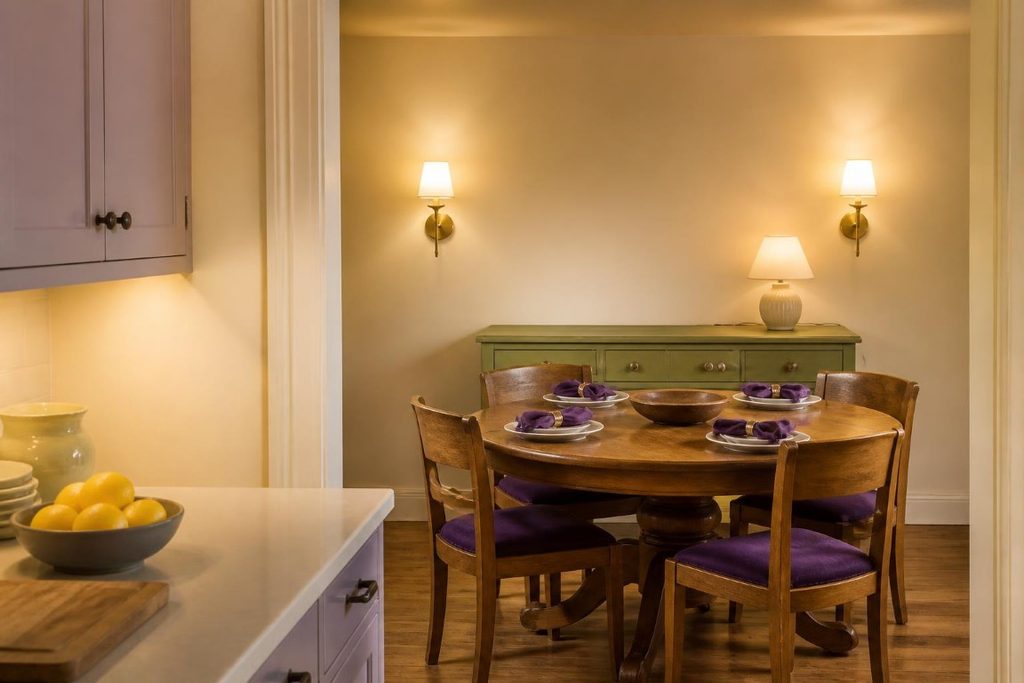
The same principles hold in every room: warm bulbs, more than one light source, light near where people sit, and some way to adjust brightness. What changes from room to room is the balance between task light and atmosphere.
Which room should you start with?
Start with the room where you spend your evenings, which for most households is the living room or the bedroom. Those are the rooms where lighting affects how the end of the day feels, so changes there are noticed first. Kitchens, bathrooms, and entryways can follow once you know what you like.
Living Room
The living room asks the most of its lighting, because it hosts conversation, television, reading, hobbies, and guests, sometimes in the same evening. Aim for a lamp beside each main seat, an overhead fixture on a dimmer if you have one, and one small accent light on a shelf or console. In our living room, the dimmable lamps sit on the larger side tables, and the plant light adds a glow of its own. For the rest of the room, see Hygge Living Room Ideas for a Cozy, Inviting Space.
Bedroom
Bedroom lighting should be easy to control from the bed. A lamp on each nightstand, reachable without getting up, matters more than anything on the ceiling. Dimmable or smart bulbs suit bedrooms well because the light can be lowered in stages before sleep, and that is the kind of lamp we keep on our nightstands. Leave candles out of this room, since the National Fire Protection Association advises against burning them anywhere people may fall asleep.
Kitchen and Dining
Kitchens need bright, even task light for cooking, and under-cabinet lighting is the most useful place to add it. The dining table needs the opposite once the food is served: softer, lower light. A fixture over the table on a dimmer, hung about 30 to 36 inches above the tabletop so it lights the table and not the diners’ eyes, lets the same room handle both.
Reading Nook
A reading spot needs a directional lamp that shines onto the page from beside or behind your shoulder. Keep some softer light on elsewhere in the room, because reading in a single bright pool surrounded by darkness is tiring. How to Create a Cozy Reading Nook in Any Space covers the chair, the table, and everything else.
Bathroom
Bathrooms are usually lit for the morning, when bright and accurate light is helpful. For evening baths, add a way to lower the light, such as a dimmer or one small, dim light. Choose fixtures and bulbs rated for bathroom use.
Entryway
An entryway sets the tone for the whole house in about three seconds. A small lamp on a console or a single sconce is usually enough. Put it on a timer or a smart schedule and you will never come home to a dark house.
Where to Start in Each Room
- Living room: make the lamp beside your evening seat dimmable.
- Bedroom: switch the bedside bulbs to 2700K or warmer.
- Kitchen and dining: add a dimmer to the table fixture or a small lamp to the counter.
- Reading nook: add a directional lamp beside or behind the chair.
- Bathroom: add one small, dim light for evenings.
- Entryway: put one lamp on a timer.
Homey Hygge Recommendation
Resist doing the whole house at once. Finish one room, live with it for a couple of weeks, and let what you notice there guide the next. Lighting preferences are personal, and the first room will teach you things no guide can.
Frequently Asked Questions About Hygge Lighting
What is hygge lighting?
Hygge lighting is warm, soft light from several light sources, arranged to make a room comfortable for the people using it. It usually means lamps at different heights, warm white bulbs, and adjustable brightness in place of a single bright overhead light. It describes an approach to light, not a particular style of fixture.
What color temperature is best for hygge lighting?
Around 2700K is the most reliable choice for living rooms and bedrooms. Bulbs between 2200K and 2400K give a deeper amber glow that suits accent lamps. Kitchens, bathrooms, and work areas often do better at about 3000K.
How many lamps should a living room have?
Three light sources at more than one height is a sensible starting point, though the right number depends on the size of the room and how you use it. A better test is whether every seat has usable light and no corner is left dark. Some rooms pass with three lamps and some need five.
Are LED bulbs good for hygge lighting?
Yes, as long as you choose carefully. Look for warm white LEDs around 2700K, a CRI of 90 or higher, and the word “dimmable” if the bulb is going in a dimming lamp or fixture. The harsh, bluish light people associate with LEDs comes from choosing a high color temperature, not from LED technology itself.
How can I make overhead lighting feel cozier?
Swap the bulbs for warm white ones, add a shade or diffuser if the bulbs are exposed, and have a dimmer installed if the fixture allows it. Then use the overhead light for tasks and let lamps carry the evening. Even a harsh fixture is easier to live with once it is no longer the only light in the room.
Can you create hygge lighting in a rental?
Yes. Nearly everything in this guide works without touching the wiring: table and floor lamps, plug-in sconces, plug-in dimmers, smart bulbs, rechargeable lamps, and string lights. Replacing the bulbs in existing fixtures with warmer ones is also allowed in most rentals, and you can take the bulbs with you when you leave.
Is hygge lighting expensive to set up?
It does not have to be. Moving the lamps you already own, replacing a few bulbs, and adding one plug-in dimmer costs very little and covers most of the system. New lamps are worth buying only once you have found a gap that rearranging cannot fix.
Let the Light Change With the Way You Live
The most useful thing to take from all of this is that lighting is not a fixed feature of a room. It can be bright and practical at breakfast, open to the sun all afternoon, and low and golden by the time the dishes are done. A home that can make those shifts easily is a comfortable one.
None of it depends on a particular look. Warm, layered light flatters a plum velvet sofa as readily as a white linen one, and it does a great deal for the books, artwork, and family photographs that make a house recognizable as yours. Good bulbs let your colors look the way you chose them.
It does not depend on candles either. I light our own home with dimmable lamps and smart bulbs because traditional candles do not work for me and I feel safer with lights, and our home is no less hygge for it. If candles bring you joy, light one or two and enjoy them.
Begin with what you have. Open the curtains, move a lamp to the seat where you spend your evenings, and change one bulb. Then pay attention to how the room feels at nine o’clock, because that will tell you what to do next.
Continue Creating Your Homey Hygge Home
The living room is where most of us spend our evenings, which makes it the natural place to put these ideas to work. Read Hygge Living Room Ideas for a Cozy, Inviting Space next for seating, layout, color, and texture to go with your new lighting.